Toggle Side Panel
Cyclr Community
  • Forums
  • Tutorials
  • Documentation
        • User Documentation >>
          • Introduction to Cyclr
          • API Guides
          • How to use Connectors
          • Navigating the Cyclr ConsoleLearn all about your Cyclr Console and configuration
          • Embedding Cyclr in your SaaS
        • View More...
        • Connector Guides >>
          • Salesforce
          • Microsoft
          • GitHub
          • HubSpot
          • Oracle NetSuite
          • Stripe
        • View More...
  • Resources
    • New Features
    • Cypher
    • DevOps Services
    • Connector Services
    • Changelog
    • Support Portal
    • Referral Program
    • Blog
    • News Archive
More options
    Sign in
    Cyclr Logo
    Cyclr Logo
    • Forums
    • Tutorials
    • Documentation
          • User Documentation >>
            • Introduction to Cyclr
            • API Guides
            • How to use Connectors
            • Navigating the Cyclr ConsoleLearn all about your Cyclr Console and configuration
            • Embedding Cyclr in your SaaS
          • View More...
          • Connector Guides >>
            • Salesforce
            • Microsoft
            • GitHub
            • HubSpot
            • Oracle NetSuite
            • Stripe
          • View More...
    • Resources
      • New Features
      • Cypher
      • DevOps Services
      • Connector Services
      • Changelog
      • Support Portal
      • Referral Program
      • Blog
      • News Archive
    Close search
    Home » User Documentation » Cyclr Console » Handling Transaction Errors

    About Cyclr

    7
    • Introduction to Cyclr
    • Glossary
    • Tasks
    • Errors
    • Minimum Requirements
    • IP Allow List
    • Legal notices

    Cyclr Console

    14
    • Partner Console Dashboard
    • The Builder
    • Reports
    • Partner Account Details
    • General Settings
    • Notifications
    • Embedding Customization
    • Security settings
    • Data Retention settings
    • Custom Service Domains
    • Handling Transaction Errors
    • Payload Size Limitations
    • Performance tips
    • GitHub Integration

    Connectors

    38
    • Introduction to Connectors
    • Connector Installation Overview
    • Connector Settings
    • Handling Connector Releases
    • Connectivity Comparison
    • Connector Guides
    • Application Connectors
      • Introduction to Application Connectors
    • Utility Connectors
      • Introduction to Utility Connectors
      • Counter Storage
      • Cross Updating Preventer
      • Data Tools
      • Entity Cross Ref Storage
      • Generic File
      • Generic File Downloader
      • Generic Form
      • Generic Webhook
      • Data Storage
        • Introduction to Data Storage
        • Global Data Storage
        • Global Object Storage
        • Cycle Data Storage
        • Cycle Object Storage
    • Custom Connectors
      • Introduction to Custom Connectors
      • Methods
      • Triggers
      • Last Successful Run Date
      • Parameters
      • Data Types
      • Paging
      • Custom Objects
      • Dynamic Custom Fields
      • Automatically Install Webhooks
      • Connector Standards
      • Settings
      • Custom Connector Authentication
      • Rate Limits
      • Scripting
        • Scripting Introduction
        • Scripting Events
        • Scripting Functions

    Templates

    18
    • Introduction to Templates
    • Template Settings
    • Create a Template
    • Webhooks
    • Tools
    • Connectivity Tools
    • Field Mappings
    • Add Custom Fields
    • Custom Object Method Categories
    • Test Scripts
    • Collection splitting
    • Pass data between two steps
    • Test a template
    • Template versioning
    • Introduction to Cycles
    • Stop a cycle
    • Copy Cycles as Templates
    • Import or Export Templates

    Accounts

    7
    • Introduction to Accounts
    • Account Users
    • Sub Accounts
    • Connector Authentication Link
    • Export or Import Cycles
    • Account-level OAuth Client Credentials
    • Securing Cyclr Webhooks

    Embedding

    17
    • Introduction to Embedding
    • ORBIT
    • Installing a Partner Connector
    • Embed Cyclr in an iFrame
    • LAUNCH
      • Introduction to LAUNCH
      • User Experience
      • Customize Appearance
      • Build Compatible Templates
      • Handle LAUNCH callbacks
      • Deploy LAUNCH
    • Marketplace
      • Introduction to Marketplace
      • Set up a Marketplace
      • Styling Marketplace
      • Deploying a Marketplace
      • Marketplace Callback
      • Marketplace Webhook Callback
      • Marketplace Settings

    API

    21
    • Introduction to the Cyclr API
    • Authentication
    • Authorize Account API calls
    • Install Connectors into an Account
    • Install a Cycle from a Template
    • Configure a Step
    • Activate a Cycle
    • Install Connectors
    • Create an Account
    • API Example Walkthrough
    • MCP Servers
      • MCP Servers API Endpoints
    • Connector Authentication
      • Introduction to Connector Authentication
      • API Key Authentication
      • HTTP Basic Authentication
      • OAuth Authentication
    • Data on Demand
      • Introduction to Data on Demand
      • Account-level Data on Demand
      • Get Account Connectors
      • Get Connector Methods
      • Call a Connector Method
      • IP Restriction

    Deep Data Ingestion

    3
    • Vector Databases Introduction
    • Preparing and Ingesting Data into Vector Databases
    • Querying & Retrieving Data from Vector Databases

    Near Real-Time Actions

    6
    • Generic Webhook
    • Introduction to Data on Demand
    • Get Account Connectors
    • Get Connector Methods
    • Call a Connector Method
    • IP Restriction

    MCP Servers

    3
    • Introduction to MCP Servers
    • MCP Server Templates
    • MCP Workflow Tools

    Release Notes

    42
    • Introduction to Release Notes
    • 2026
      • 2026-09
      • 2026-08
      • 2026-07
      • 2026-06
      • 2026-05
      • 2026-04
      • 2026-03
      • 2026-02
      • 2026-01
    • 2025
      • 2025-11
      • 2025-10
      • 2025-09
      • 2025-08
      • 2025-07
      • 2025-06
      • 2025-05
      • 2025-04
      • 2025-03
      • 2025-02
      • 2025-01
    • 2024
      • 2024-12
      • 2024-11
      • 2024-10
      • 2024-09
      • 2024-08
      • 2024-07
      • 2024-06
      • 2024-05
      • 2024-04
      • 2024-03
      • 2024-02
      • 2024-01
    • 2023
      • 2023-12
      • 2023-11
      • 2023-10
      • 2023-06
      • 2023-05
      • 2023-04
    • Archive
      • Archive
      • 2022
      • 2021
    View Categories
    • Home
    • Documentation
    • Cyclr Console
    • Handling Transaction Errors

    Handling Transaction Errors

    6 min read

    Transaction Error Webhook #

    Cyclr’s Transaction Error Webhook feature enables you to be notified when Step Errors (and optionally Step Warnings) occur in your integrations, as a way of alerting you or your support staff.

    Notifications are sent as HTTP POST requests to a URL you specify. They include JSON content in the request body that provides details of the error – or warning – encountered.

    They can be turned on from within your Cyclr Console under Settings > General Settings, then by selecting the Enable Transaction Error Webhook option, providing a URL for Cyclr to notify, and selecting the Save button at the bottom of the page:

    You can also choose to be notified when Step Warnings occur by using the additional Transaction Error Webhook Include Warnings option.

    Account-level Override #

    If you wish, you can choose to handle errors in particular Cyclr Accounts differently by using the Account-level override.

    In your Cyclr Console, go to Accounts > Account Management, click Settings for the Account you wish to set this for and use the Transaction Error Webhook options found there. They work in exactly the same way as the Console-level options.

    Transaction Error Webhook URL #

    The URL you set for the Transaction Error Webhook could be for a third party system or a system of your own; any URL that will accept a POST request containing the JSON data Cyclr includes.

    You’re also able to send these notifications to a Webhook Step in a Template or Cycle within Cyclr itself, allowing you to process the data using Decision Steps and other tools, just as you would any other data in Cyclr. This enables you to install Connectors such as Slack or SendGrid as a way to alert you, or database Connectors to log the details for future reference.

    If you choose to handle these notifications within Cyclr, you should install the Error Webhook Connector which knows the structure of the request data Cyclr sends so is simpler to setup than perhaps using a standard Generic Webhook Connector’s Webhook Method.

    Note: Using Cyclr’s Error Webhook Connector does not count towards your Connector Allowance, though Tasks used by Steps using its “Webhook” Method do count towards your Task Allowance, where present.

    Handling Errors within Cyclr #

    1. It is recommended to create a separate Folder perhaps called “Monitoring” to put your Template or Cycle into. It’s up to you whether you do this in your Cyclr Console as a Template or create a new Account dedicated to these types of processes.
    2. Install the Error Webhook Connector – it has a Webhook Method which knows the structure of Cyclr’s Transaction Error Webhook requests.
    3. Add that Connector’s Webhook Step to your integration.
    4. In the Webhook’s Step Setup, select and copy the Webhook URL value.
    5. Go to your Cyclr Console, and select Settings > General Settings.
    6. Tick the box for Enable Transaction Error Webhook
    7. Paste in the URL you copied from the Webhook Step.
    8. Select the Save button to store those settings.

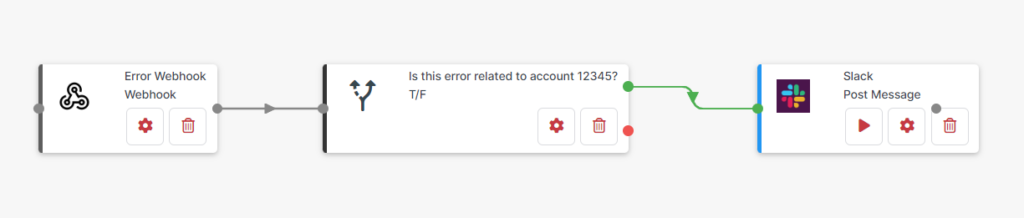
    Now you can go back to the Cycle where you added the Webhook Step, and add any Decision Steps, etc to filter how errors will be handled.

    In the example below, any errors relating to “Account 12345” will trigger a message in Slack.

    Example Transaction Error Webhook Payload #

    This example shows an error from Salesforce’s API when calling the “Get Account” Connector Method:

    {
        "Timestamp": "2025-04-11T07:37:47.455544Z",
        "AccountId": "0bd9f087-8db9-46e9-8640-e8eb8a6fd635",
        "AccountExternalId": "0bd9f087-8db9-46e9-8640-e8eb8a6fd635",
        "AccountName": "Templates",
        "CycleId": "a2115f94-4ee6-4c4b-a03c-f89ce5ec41ed",
        "CycleName": "SF Updated Opps to Google",
        "StepId": "5c881e9f-5a38-4544-9b36-562baf4a2e71",
        "StepName": "Get Account",
        "StepType": 1,
        "TransactionId": "284bc7b4-4321-4c97-aa2f-370f9627d244",
        "Message": "Failed to call the method",
        "Detail": "404 Not Found\r\n[{\"errorCode\":\"NOT_FOUND\",\"message\":\"Provided external ID field does not exist or is not accessible: AAA\"}]\r\n\r\n\r\nHTTP Request:\r\nGET https://xxxxxxxxxxxxxxxxx-dev-ed.my.salesforce.com/services/data/v43.0/sobjects/Account/AAA?fields=Name HTTP/1.1\r\nAccept: application/json\r\nAuthorization: REDACTED\r\nUser-Agent: Cyclr, (https://cyclr.com)",
        "DetailTruncated": false,
        "IncidentLevel": "Error"
    }

    The information in the Detail property contains the original response Cyclr received from Salesforce.

    As a result, it will change depending on the API being called and how that API formats its error responses.

    If there are specific errors you wish to handle, you may need to force them to occur so that you can view their responses to see what information they contain.

    Payload Properties #

    PropertyDescription
    TimestampString
    An ISO 8601 date/time string, indicating when the error occurred.
    AccountIdString
    The Cyclr ID of the Account where the error occured.
    AccountExternalIdString
    The API ID of the Account where the error occurred
    AccountNameString
    The Name of the Account where the error occurred.
    CycleIdString
    The ID of the related Cycle.
    CycleNameString
    The Name of the related Cycle.
    StepIdString
    The ID of the Step in the Cycle.
    StepNameString
    The Name of the Step in the Cycle.
    StepTypeInteger
    Indicates the type of the Step where the error occured.

    Values are:
    0 – None
    1 – Action
    2 – Webhook
    3 – Decision
    4 – Delay
    5 – WaitUntil
    6 – WaitAll
    7 – WebhookResponse
    8 – Annotation
    9 – Switch
    10 – McpRequest
    11 – McpResponse
    TransactionIdString
    The ID of the Transaction the error occurred within.
    MessageString
    A short description of the error.

    Possible values:
    *Trigger Skipped
    *Transaction Stopped
    *Out of retries
    *Failed to authenticate the connector
    *Required source is empty
    *Webhook failed
    *Failed to build the request
    *Response data not in expected format
    *Failed to call the method
    *Response data fields missing
    *Step data cannot be split
    *Failed to split transaction step data
    *Failed to save the webhook response
    *Failed to return the webhook response
    *Failed to build the webhook response
    *Failed to find the webhook source key
    *Failed to get webhook trigger step data
    *Failed to find webhook trigger step
    *Wait Until Failed To Run
    *Wait Until is over retention period
    *Field is not a valid DateTime
    *WaitUntil step is missing wait criteria
    DetailString
    The original error received from the external system.
    If this is longer than 5,000 characters, it will be truncated and the separate DetailTruncated property will be set to true.
    DetailTruncatedBoolean
    If the original response from the external system was longer than 5,000 characters, Detail will contain a truncated version ending in ... and DetailTruncated will be true, else false.
    The original response can be retrieved through the Cyclr API by retrieving details of the Transaction.
    IncidentLevelString
    Indicates how Cyclr recorded the error:
    * Error – recorded as a Step Error.
    * Warning – recorded as a Step Warning.

    Step Warnings will only be sent by Cyclr if the additional Transaction Error Webhook Include Warnings option has been enabled.
    Custom Service DomainsPayload Size Limitations
    Page Contents
    • Transaction Error Webhook
      • Account-level Override
    • Transaction Error Webhook URL
    • Handling Errors within Cyclr
    • Example Transaction Error Webhook Payload
      • Payload Properties

    Company

    • Company
    • About Us
    • Security and Compliance
    • Pricing
    • Blog
    • Branding
    • Embedded iPaaS
    • Release Notes

    Legal

    • Website Terms
    • Privacy Policy
    • Terms and Conditions
    • Data Protection Agreement
    • SLA
    • GDPR

    UK Office

    +44 (0) 3300 102 525

    US Office

    +1 (646) 585-2525

    Cyclr Logo

    White labelled API integration framework for creating & managing in-app SaaS integrations.

    © 2026 Cyclr. All rights reserved.